


October is often spooky season. I confess my family does not observe Halloween. That does not stop me from going out into my woods on a fallish evening and listening to the whisper of leaves falling to the forest floor, and deer moving off to my right. I love a good restrained horror story. So much so every other year I open up Frank Peretti's The Oath, one for the story, and two for the deeply spiritual allegory of it.
It is that allegory and exploration of the horror of human nature that I find satisfying. It is why this month White Harvest Media is featuring a post-apocolyptic horror, being serialized right here on Substack.
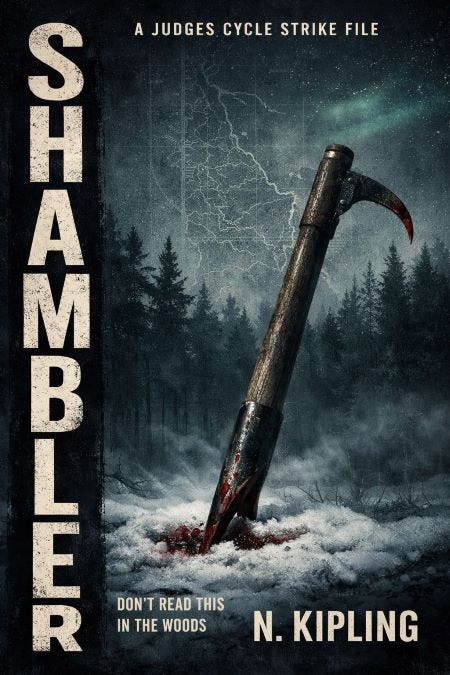
Stories told from old frameworks are some of the best literature out there. Stories told with biblical principles are even better. To seed a series, White Harvest decided to introduce N. Kipling and the types of stories that arrive from that pen name with Strike Files first: short stories designed to help the reader engage with the read before the novels arrived.
The American Judges Cycle was born from an idea that asked, “What if?” Most of N. Kipling’s stories start with that question. It’s all speculative. Kipling asks the question over and over: What happens to people when systems break?
The AJC seeks to answer that question by throwing a future America, and even the world, into a judgment. Instead of the end of time, Kipling’s characters face a type of Flood or Babel judgment. God uses the sun to judge the earth. Solar flares cover the globe, and even hardened military equipment fails. For forty days and forty nights, aurora borealis are seen globally: six weeks of electrical interference such as the world has never seen.
The humans who survive the judgment revert overnight to eighteenth- and nineteenth-century tech to live. Tribalism returns because there is no longer a contiguous federal system with the reach to keep legitimacy. It is out of this chaos that the Judges premise succeeds: “There was no king in Israel and every man did that which was right in his own eyes.”
The first Strike File belongs to Shambler because it mirrors the single lonely verse of Shamgar, the judge who stood up and used a farming implement to kill six hundred Philistines in a valley.
The stage is set for Kipling’s hero. Former Special Operations, the man had worked for the federal government most of his adult life. Trained to work with a unit or alone, Shane survived his first four years after the CME on skill and competence. He believes he does not need others; he is hard enough to take care of himself. But the threat is real, and it’s after the children of the valley, especially one specific child Shane swears to protect.
He is old. His back aches, and so do his knees. This is not a special operator in the prime of his life. He figured he would die alone and had made peace with it years ago.
But like the deliverers of old, Shane finds himself uniquely suited to the challenge before him. Perhaps that is what Kipling is trying to tell us: that systems break and true character is revealed.
Shane learned the doctrine of Joint Special Operations Command; he integrated discipline into his life. The book will follow Shane through winter as he hunts down a cult born from a doctrine and ideology of their own, also integrated. Only one of those doctrines gets to be right. Both are carried to the extreme logical conclusion of their implementation. Neither doctrine proves morality.
Kipling is simply exploring the question of the lengths a person is willing to go to survive and what that means for the other people around them. Shane is a hero because his basis for right is established according to God’s truth. That, to me, makes this fiction worth reading, not because Shane is a cool guy superhero, but because he never lost a sense of right and wrong in a world where right is determined subjectively.
If that is the kind of hero you want to read, this story is probably for you. Chapter’s drop on Fridays through White Harvest Access. Current publication schedule is every two weeks.