


The music swells in the large auditorium with the stained glass windows.
Ho, my comrades,
see the signal waving in the sky.
Reinforcements now appearing,
victory is nigh.
Hold the fort,
for I am coming,
Jesus signals still.
My daddy picks up his Bible and waves it.
Wave the answer back to heaven
By thy grace we will.
The hymn concludes, and the congregation sits, but I stare at my daddy. The smile he gets on his face when we sing that song. The fervor with which he sings it, I am mesmerized.
So I ask him after church.
“Daddy, why do you like that song so much?”
He turns to me with a smile, and a twinkle in his eyes. “I like it because it is a faithful man’s song.”
Someday, I will understand the theme of that song. My daddy was right.
The Radio Preacher
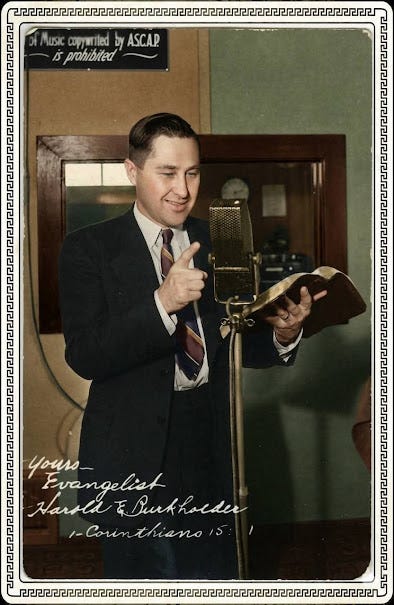
This is my Great-Grandfather Harold Burkholder. Originally of Plainville, Kansas, he met and married my great-grandmother, Irma, in the 1920s. After they moved from Kansas to Colorado, during the days of the Dust Bowl, my great-grandparents joined Tabernacle Baptist Church in Denver. It was under the ministry of Harvey Springer that Harold surrendered to preach for Jesus.
God had to break him first, and that is a story for another day, but it was God who did the rebuilding too. He started the Colfax Baptist Church, which later became Westland Baptist Church in Denver.
The father of eight boys and three girls, one of whom was my grandmother, the man fondly referred to as grandpa-great by my generation, adored his family. He loved Jesus most of all. When he preached, he preached Jesus. When he spoke with strangers, or family he spoke of the gospel. A fire for seeing souls saved burned in his heart. A man with a prophetic gift, he was often described as being before his time.
In 1959, having been given a clean bill of health that week, he was dressing for bed one night. The account is that he froze, looked up at the ceiling and gasped with wonder and awe. “Oh Irma—,” before he collapsed from a massive heart attack. I believe my great-grandfather saw Jesus just before he died that night.
I did not know him personally. I was not born for another thirty years, but his impact and legacy still press on me today. He was faithful. He pursued the salvation of his children with tenacity. He discipled them to love Jesus, and that same heritage was passed down generation to generation to me.
The Farm Boy
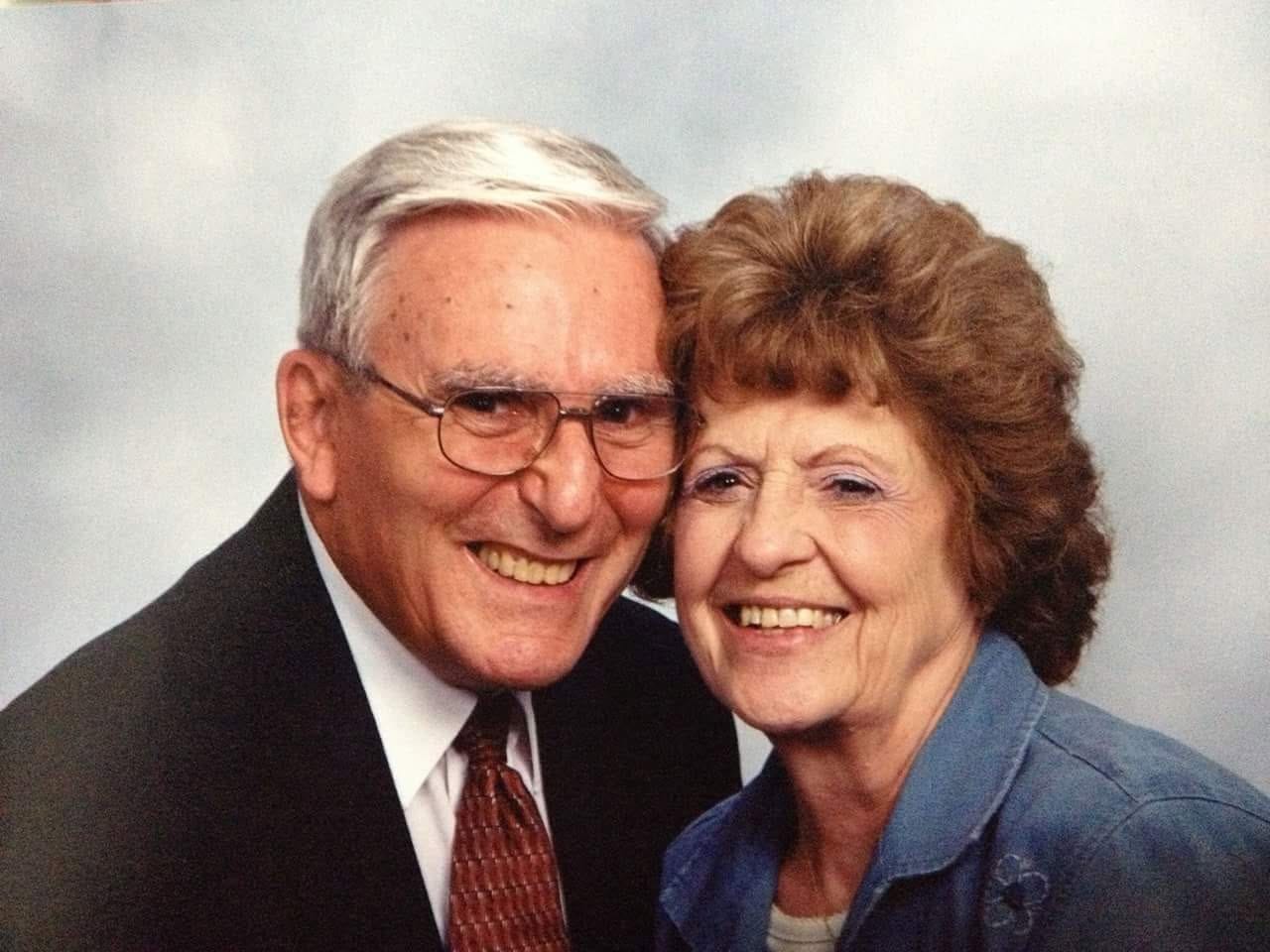
My Grampy, Howard Musgrave, was born in Kiowa, Colorado, on a working dairy farm during the Great Depression. The third brother in a family of seven boys and one girl, he was shy to the point of phobia, he preferred to hide in the barn when company came rather than be forced to speak to strangers. Yet the first time he met my grandmother at nine, he was determined she would be his wife.
He did indeed succeed in his quest and in October of 1955, he wed Naomi Burkholder in a ceremony performed by Harold. He was a truck driver in the family business for years, and like my great-grandfather, God had to get his attention too, before he surrendered to preach. He told God no again and again, relating to Moses, when he told God, “I am a man of slow speech.”
The idea of public speaking terrified him. But after several close calls in his truck, my grandfather said, “Whatever you want, Lord, I will go where you want me to go, and be what you want me to be.”
God called them to Chile to be missionaries in 1968, where they began to learn the Spanish language. They left the country in the lead-up to the civil unrest under President Allende’s administration, and returned to the United States for a short time.
It was later that year when my Grampy came to my Grammy and said, “Venezuela.” At the time their missions board was pushing Ecuador in the wake of the martyrdom of Jim Elliot, Nate Saint and the others, but God’s plan was different for my grandparents. They went to Venezuela and ironically the farm boy ended up in the middle of the urban sprawl of Caracas.
There my grandfather, who was still terrified of public speaking, preached his first sermon in Spanish. He labored in Venezuela for the next eighteen years. His adventures while preaching the gospel included pulling an anaconda from a church member’s toilet. Ironic, since his only fear larger than public speaking was snakes. He visited the Venezuelan villages of the amazon, flew over Angel Falls, and even protected my grandmother from a drug cartel that stopped them on the highway between Caracas and Maracay, and dragged her from the car.
That story goes they were stopped, my grandmother was dragged from the vehicle, with a knife to her throat. My grandfather, did not think twice, that was his girl. He grabbed a steering wheel club from the van and ran around the front yelling as loudly as he could, while swinging the club. The story goes the men scattered, whether it was shock of seeing a missionary yelling like a mad man, or divine intervention, both of them escaped with their lives and the van.
When I was eight years old, I got to go with my grandparents to Venezuela to take part in their ministry. I visited barrios with my grandpa and watched him love on the people. I helped them prepare meals to invite dozens of church people into their home. It was from him I learned church is not a building; it is people. It is community. It is family.
In 2001, God saw fit to allow my Grampy to suffer a brain aneurysm. He would spend the next five days in a Venezuelan hospital on the verge of death. When he finally came home the doctor in the hospital in Colorado told us that if he had not passed yet, he was optimistic about him making it to rehab, but that it was unlikely he would ever walk again.
Before this, I had been slightly intimidated by my grandpa’s stoic demeanor. But over the next two years, my grandpa became my friend. We would sit and watch westerns. As a farm boy he loved The Lone Ranger, Rifleman, and Bonanza. I would make us tea. (he hated coffee) There we would sit in the den of our house, watching those old shows and talking about the lessons they were trying to instill.
Therapy was hard, and he lived in constant nerve pain. His sight was so damaged from the brain injury that he could not read his Bible. He took to listening to it on tape. He never complained, but he would sit and rub his dead limbs and the family learned. Those were the times he was suffering.
By a miracle God led them to an ophthalmologist in Pueblo, Colorado, who worked with my grandpa to restore much of his sight. And he did walk, haltingly, painfully, and with a cane, but he did walk again.
In 2003 they returned to Venezuela, where they stayed until Maduro's policies forced them to leave in 2007. It was during this time that my family moved to Oklahoma, and I began to struggle with my faith. When my grandparents returned to the States for medical checks and furlough in 2004, my mother sent me to live with them for the next four months. My questions concerned her. I wanted to know how you could know it was real. How could you know it wasn’t made up.
It was my grandpa who took the time to love on me. He would sit with me for hours, pointing to the scriptures. He never got frustrated he would speak to me with so much love in his heart, and deep concern in his voice. He prayed for hours on end for my soul, even fasting at one point due to his burden. I grew so used to seeing him in his chair, poring over the Word with a magnifying glass, I would often see him there in my mind’s eye, even after he was gone.
It was on that trip that I met God as my God, and not just my Savior. It was my grandpa’s prayers and wrestling that brought me home. When I went to Bible College, I became the in-home caregiver for my cousin Randall, who lived at my grandparents’ house. I saw my grandpa every day. Made him lunch and more than once my homework assignments sparked fervent and sharpening conversations about the Bible.
If there was one book he loved best, Grampy loved God’s word. He would get this glow on his face when we would talk about Jesus. It invited the person with whom he was talking to want to know more about the Galilean who had saved a farm boy and used him in the lives of hundreds of Venezuelans. His awe, his passion, his pursuits were always to fall deeper in love with Jesus.
My grandpa went to his Home in 2011, and I still miss him today. I will often open God’s word, find a nugget of gold that seems exactly for me, and ache to call him. He listened. He loved. He obeyed God. And he never lost the wonder that God would take an imperfect Farm Boy and use him to build his Kingdom. Part of who I am today was deeply shaped by this quiet, gentle man, who was faithful.
Faithful to the Finish, Faithful to the Call
Looking back, I realize these men taught me that faithfulness is rarely spectacular. It is mostly ordinary obedience repeated over a lifetime. Neither my grandpa nor my great-grandpa got long on this earth by the world’s standards. But the mark they left, in the short time they had is still paying out dividends today.
One of my professors in Bible College, whom we all called Coach Thomas once said.
“The best way to spend your life is to invest it in something that will outlast it.”
In my May Fourth article It’s Not How You Start—It’s How You Finish I wrote:
Because the measure of success in the Father’s economy is never finishing first—it’s finishing well. As for me, when I finish this race, I hope to leave with nothing left.
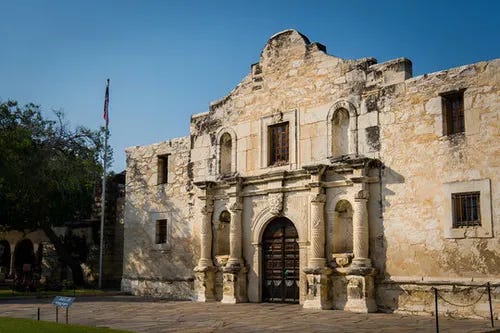
It is because I have had many examples on how that is done. Leaving with nothing left is my goal. It is no accident I used the picture of the Alamo to illustrate this article. Those men laid it all down, to buy Sam Houston the time.
So too these men that I will be sharing in this three-part series, have given so much for souls; to buy them time, to pray for them, to love on them, to invest in them when it cost them comfort, fame, wealth, and time. I am one of those souls, and I will always be grateful for that sacrifice.
To these men I say thank you. Thank you for being faithful to the finish, and faithful to the call. Thank you for holding the fort.
It’s quite the legacy our fathers and forefathers left to us. This story of their lives and the influence they have still, on you is beautiful. Thank you for reminding me of my own memories and the legacy left to me in Christ. G. Wray (Gilda’s husband)
Thank you so much for taking the time to read my stories.
It blesses my heart that it reminded you of your own.