


The wind blows my hair as I step out of my family’s Astro van. Beside me is a highway. Underneath my feet is gravel that crunches. I walk to the edge of the lookout where a six-foot chain-link fence keeps visitors well away from a 200-foot drop-off.
The view is incredible. The high Rockies stand all around.
“Jessica.”
I turn to find my dad holding the video camera. He always does this on vacation.
“Can you tell me where we’re at?” he asks.
I think about it for a second, and I can’t remember the name. I know it’s an animal. I look shyly into the camera. Wind blows hair into my mouth. I remove it.
“I don’t know,” I say.
Daddy chuckles. “We’re on Wolf Creek Pass.”
“Wolf Creek Pass,” I say with confidence now.
He chuckles again.
I turn to look out at the mountains and smile. They’re rugged and dangerous and beautiful.
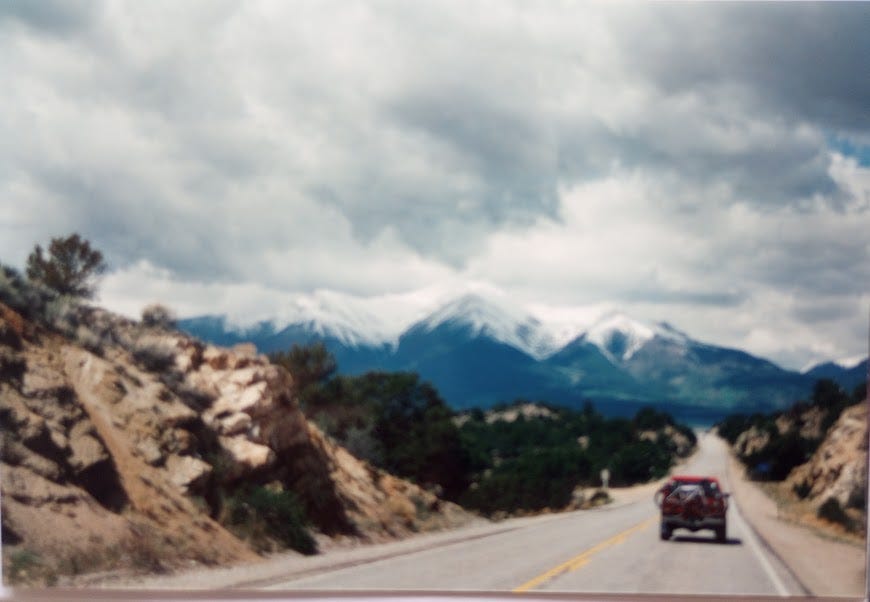
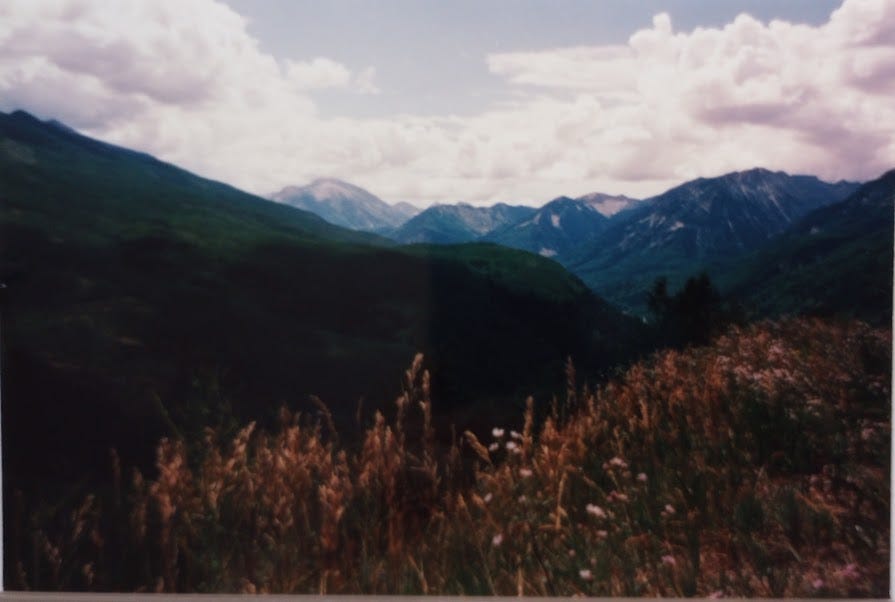
My family took trips through the Colorado Rockies every summer for nearly eight years in a row. Every summer my dad would pack up our minivan, put the cargo carrier on top, sometimes haul a trailer, and up over the mountain passes we would go. Through Eisenhower Tunnel, over Monarch, over Wolf Creek, and through some of the most beautiful country I knew.
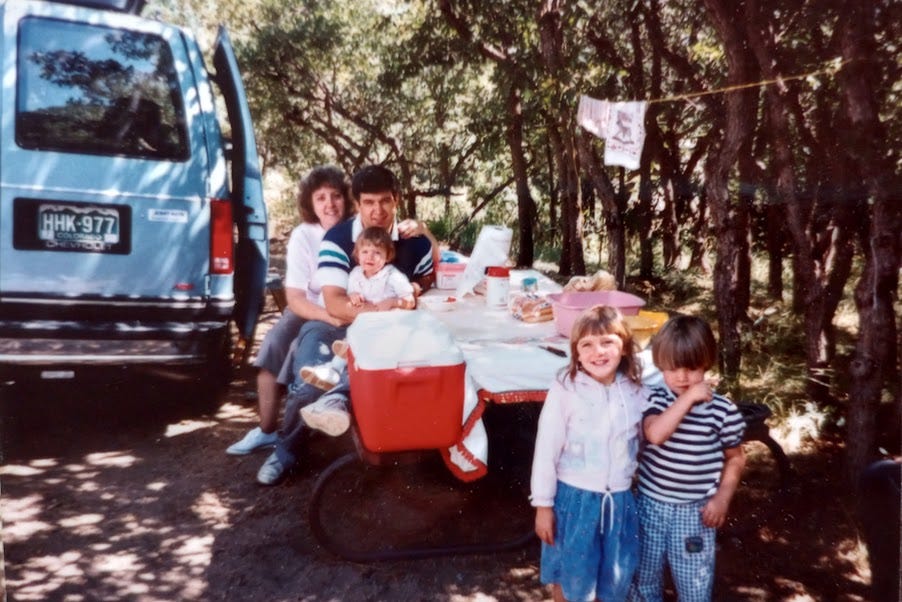
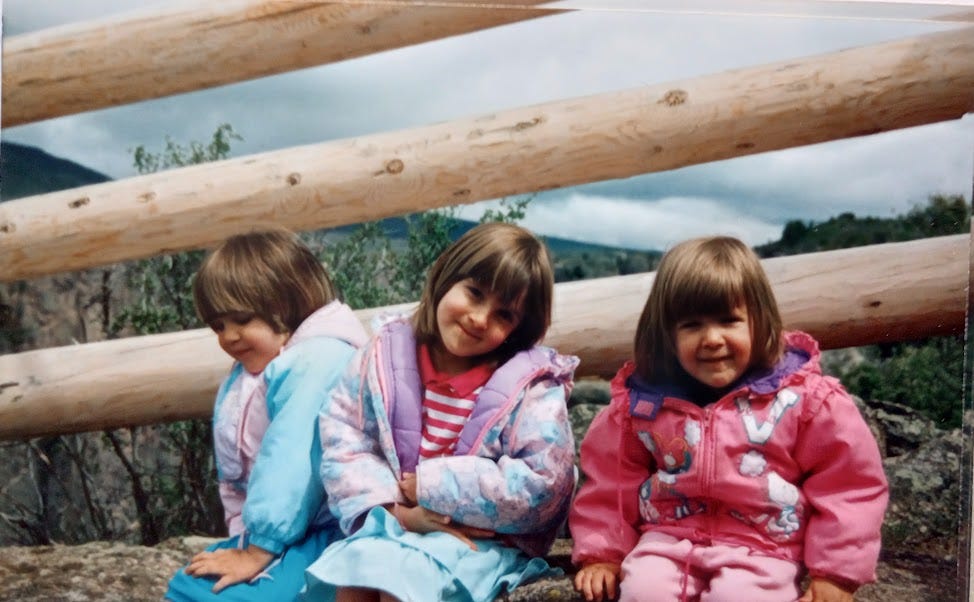
My parents Richard and Barbara, Me, in the front with the smile, and my sister Sarah. My sister Hannah held by my dad.
If you’ve read NONE, Chapter 10, “Competence,” this is the country I had in my head when Michael traverses the San Luis Valley with Mr. Bayless’ Silver.
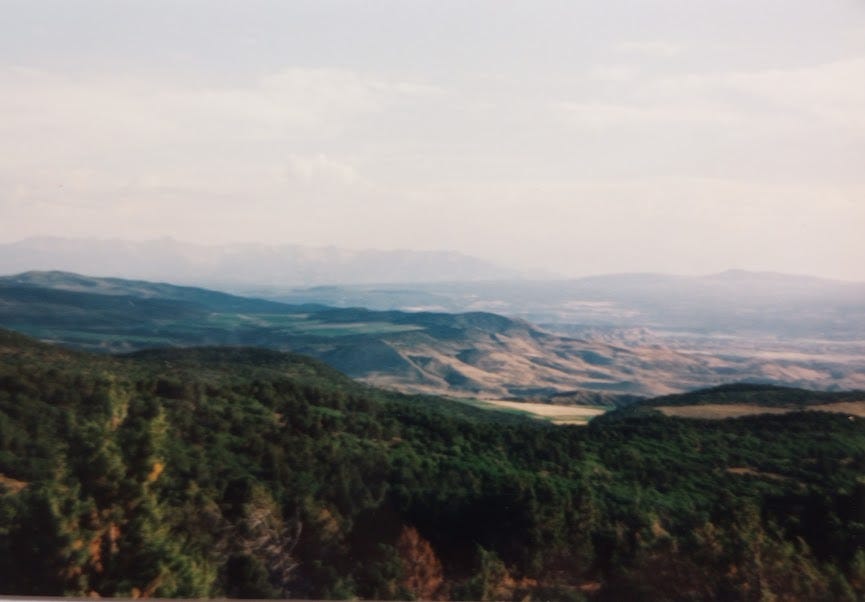
I look at these pictures now with fondness and nostalgia. I remember mornings waking up to golden sunlight and hearing a meadowlark outside my window. In the late summer the grass would often already be dry, but in the mountains the weather was cool enough that we all wore sweatshirts and sweatpants to hike even in the middle of July.
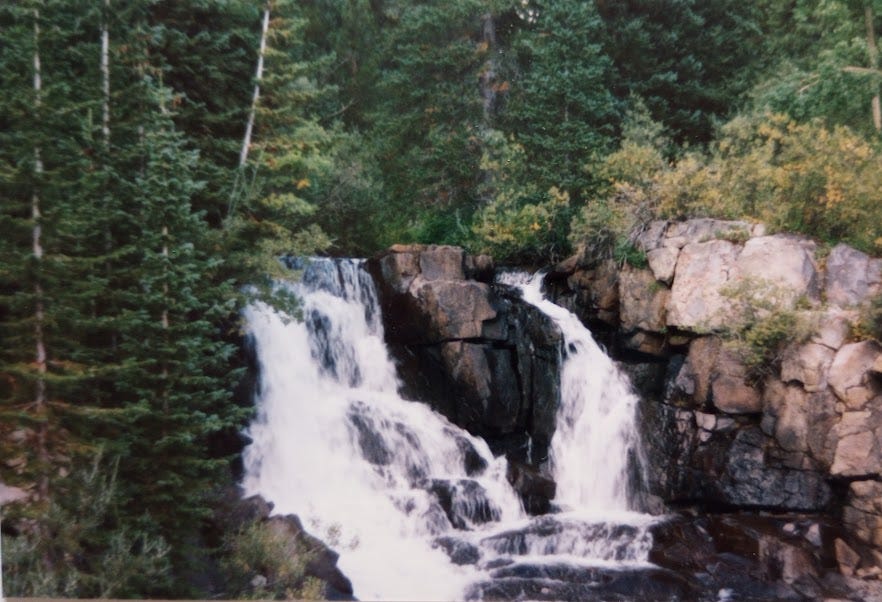
My dad would always stop and take pictures of waterfalls.
The Uncompahgre River ran through the country where we visited family near Montrose. Blue Mesa was another regular stop, where my family would spend summer afternoons fishing. Some of my best memories are helping my cousin Rich gut fish, and then we would walk away with scales all over our shirts. It may have smelled terrible but they were shiny in the sun.
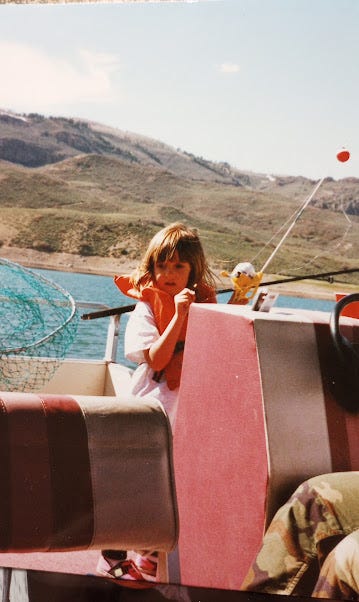
5 year old me on the Ragin’ Cajun, fishing at Blue Mesa Reservoir
My favorite part, though, was the fact that my cousin was a Montrose County deputy sheriff. More than once he let us ride in the back of his squad car. He was the K-9 unit handler, and one of those German Shepherds actually ended up in our home when she was retired.
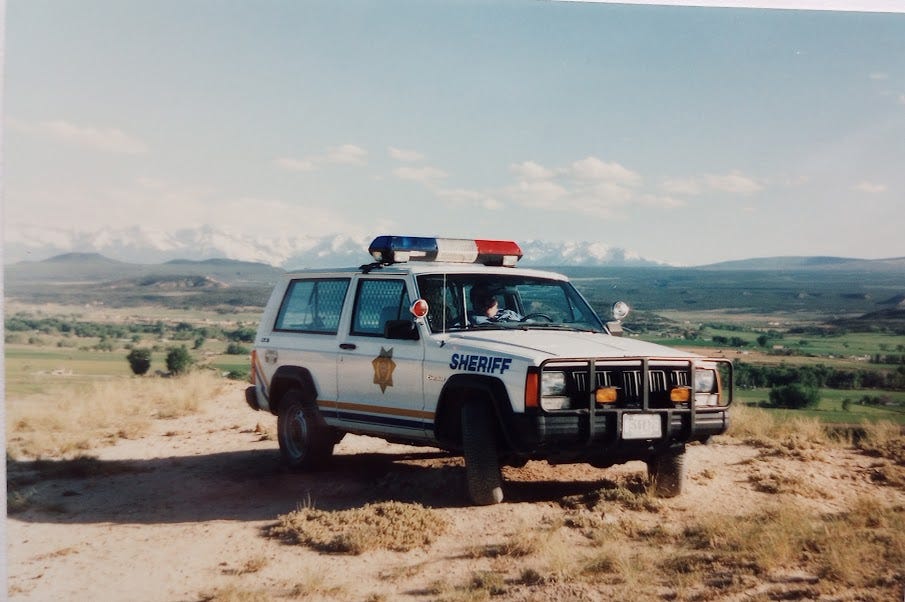
Those are the kinds of vacation memories that still bring a smile to my face.
And so I introduced my readers to them because I wanted the world to see what I knew about Colorado through Michael’s eyes.
I could spend hours describing the smell, the sound, the wind.
It was home.
In some ways it still is.
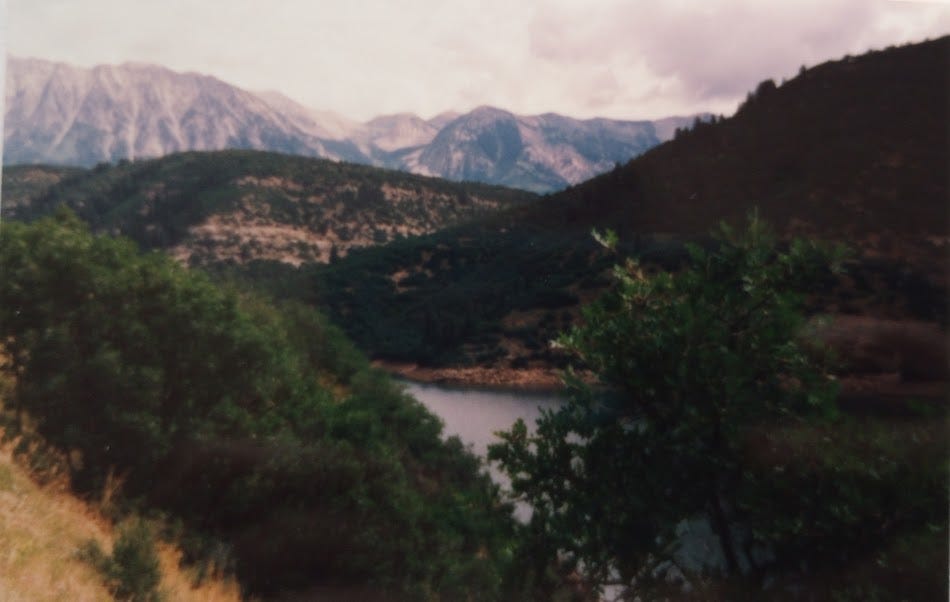
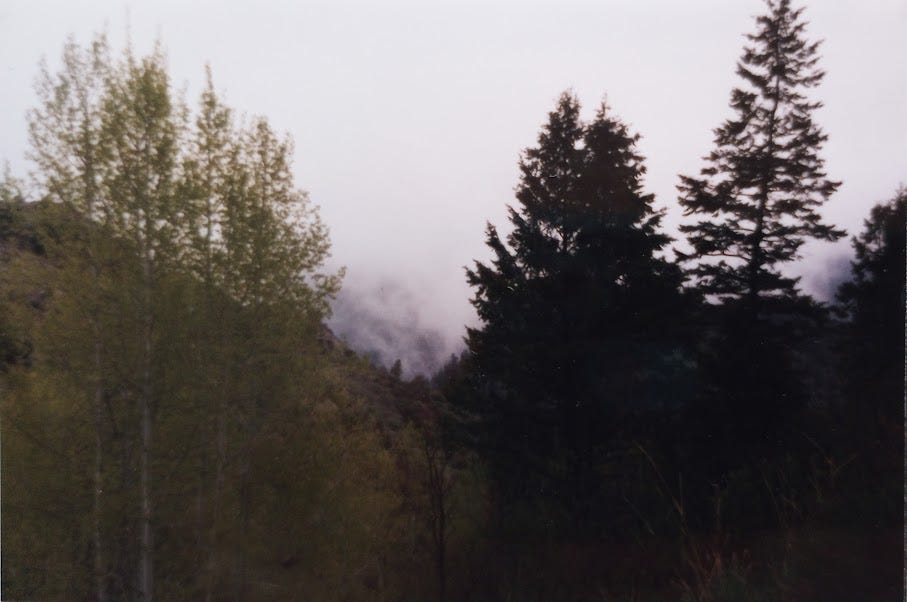
The way that the thunderheads move over the mountains in the afternoon, and it never fails to rain. A thirty-minute quick burst of shower before moving on. A day spent on the Blue Mesa of the Gunnison fishing. Cleaning those same fish and eating them for supper that night. It was where I fired my first rifle, built my first campfire and learned how to ride my first horse.
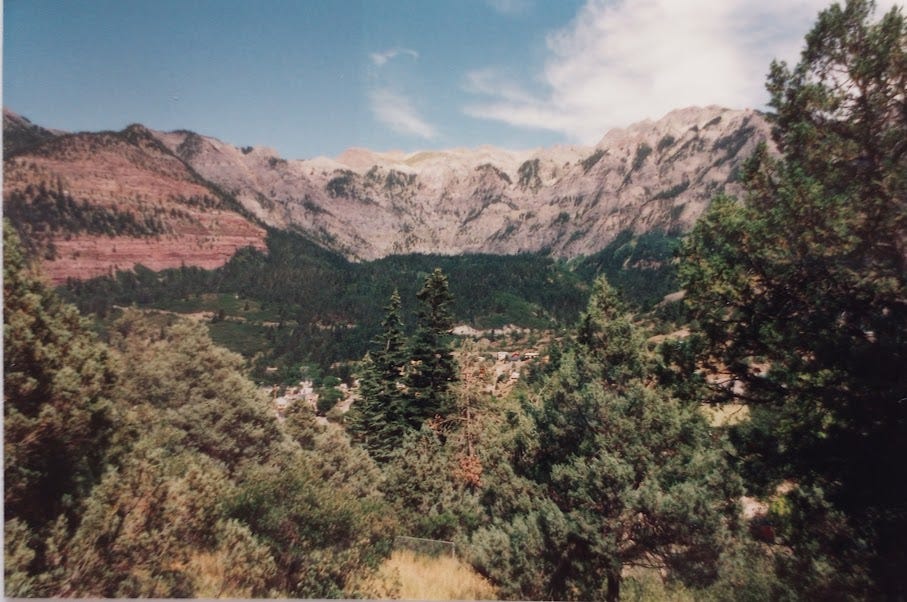
The history of that country fascinated me too. Mining shaped much of Colorado, and silver became enormously important in the San Juans. Before railroads made moving freight through those mountains easier, men and animals had to move supplies through incredibly difficult country.
In Michael’s time, that could mean mules and pack animals carrying hundreds of pounds of freight over harsh mountains.
That was the work.
It was also an easy place to get ambushed, which is why I picked it for Michael’s first real trial of competence.
And for his final trial I picked somewhere closer to where I live now: the Black Mesa country around Oklahoma, New Mexico, Colorado, Kansas, and Texas.
I describe an isolated placita, a small settlement where Anglo and Hispanic families came together to run cattle. They were small outfits, often pressed by larger ranching interests that controlled huge swaths of land in that part of the West.
The other thing that interested me about that particular area is the fact that I travel it often with my family.
Since my husband’s mother lives in Amarillo, Texas, we will drive I-40 to Amarillo and then leave her house and drive the back roads up through Dumas, Texas, cross out of the Panhandle into New Mexico, and drive through Clayton.
This is one of my favorite drives.
That particular northeastern corner of New Mexico is still incredibly isolated, with land as far as the eye can see. You’ll often be driving and see a mesa in the distance, and the closer you get, it oddly seems to shrink in relative size to the mass its shadow casts.
Arroyos fill the land. What appears to be flat is actually a journey of ups and downs as you go down into canyons and then back up the other side. Scrub brush and mesquite are everywhere.
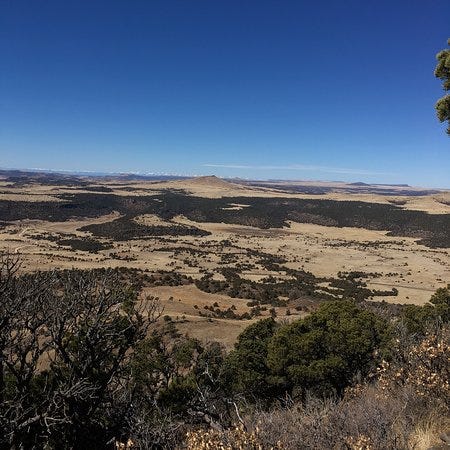
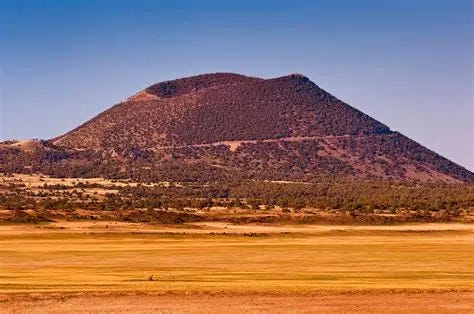
But some of the most interesting geological features are the volcanic cones.
In May, my husband and I took a trip up to Colorado with our children. On our way there, we noticed one of those cones that neither of us remembered seeing the last time we had driven through three years earlier.
That’s how isolated northeastern New Mexico actually is.
Clayton wasn’t even a town in Michael’s time. Today, it’s still a small town surrounded by miles and miles of open country.
The reason I picked that particular corner of New Mexico was because I knew it. I know how hot it gets in the Summer, and how cold it feels in the winter. I know the hiss of wind in dry grass and the call of a bird of prey. The stars out there are bold, big and bright. If wasn’t for the two lane highway, it would feel very much like stepping back into another era.
The other reason was jurisdiction.
Being from Oklahoma, I know the very, very curious history of the Public Land Strip.
In the 1880s, what is now the Oklahoma Panhandle was this strange strip of land without the ordinary territorial government surrounding areas had. It became known as No Man’s Land, and law enforcement there was complicated, to say the least.
This left a huge hole for criminals.
It was very easy for them to move through the isolated places where Colorado, Kansas, New Mexico, Texas, and the Public Land Strip came together, crossing jurisdictions and disappearing into miles of empty country.
The Black Mesa area was particularly isolated, and it would remain that way until the Public Land Strip eventually became part of Oklahoma Territory.
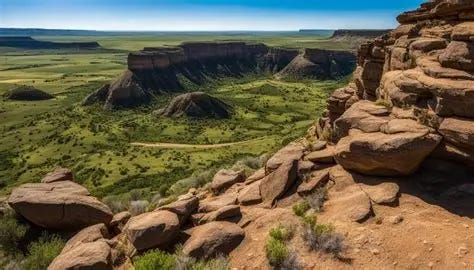
But in Michael’s time, it made sense to me why a placita being harassed by a gang of bandits would gather up their savings to hire guns to come fight a battle they were already losing.
And so that is why I placed Michael here, in this odd place of the literal Wild West.
And I suppose that is why NONE will be up there among one of my favorite books.
Because I get to introduce my readers to places I know well. Places I still travel.
One of these days, my family and I will absolutely stop and take a picture at the summit of one of those volcanic cones.
And hopefully my children will be able to say, like me,
“Oh, I’ve been there.”
It feels like home.
Oh Jessica I have so enjoyed this!
I might have already told you about me not being much a a book reader & yet, so much here on Substack has grabbed me enough for me to read through the articles.
Yours have been amongst them.
Admittedly (& in embarassed confession! 😊), I haven't read every single article, & much though I started to read the beginning chapter of your book & meant to follow it through, I am afraid the overwhelm has caught up with me & I haven't got further.
I have wanted to check in on your latest though, thus, just read this, & loved it so much it's made me want to try to go back & catch up! However, realistically, my track record has held me back from not being quick to say "I will ...", definitely not "I definitely will ..." as it will likely be a broken promise I cannot afford to make, so instead, I apologise.
However, I love your childhood memories & photo backing of them, as I feel I already have a sneak peak of your story ... thank you for sharing these precious moments 💜 💖 💗
Beautiful, Jessica; thank you for the backstory.
My family regularly travelled to Florida for vacation, via car. That's how I fell in love with the South. Many years later, my parents retired to North Carolina. That's how I got to love the Carolinas. Then, more than 20 years later, I moved to Charleston, SC. That's how I got to love the SC Lowcountry of which I write today.
Traveling to NE New Mexico, did you ever come across Angel Fire, or Taos, or Philmont Scout Ranch?